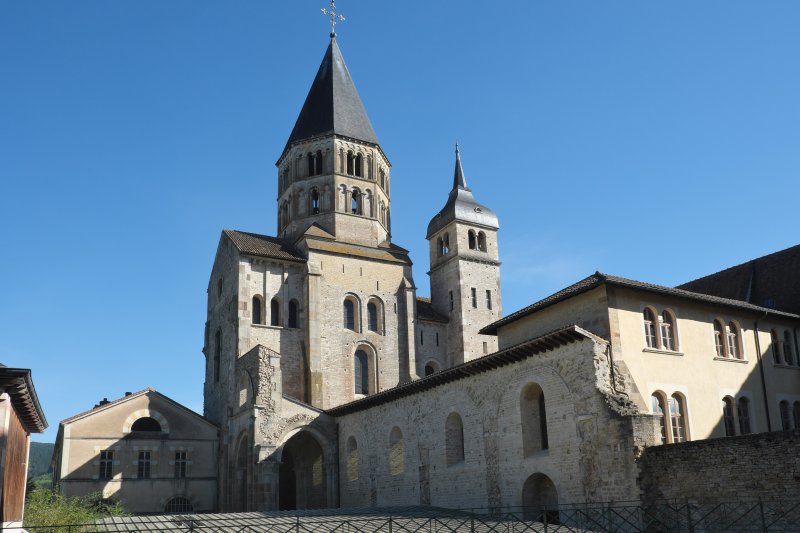
 GFreihalter, CC BY-SA
Cluny Abbey: tickets, opening hours and what to see
The Bernon ticket covers both the abbey and the Cluny Museum of Art and Archaeology, and it is the only one you can book online. Free admission is only given on site.
In short
- The Bernon ticket opens the abbey and the Cluny Museum of Art and Archaeology. It is the one sold through official online ticketing.
- The Hugues, Odilon and Urban tickets add Berzé-la-Ville or the Tour des Fromages, and you buy them at the desk.
- Under-18s and 18 to 25 year olds enter free, but free tickets are only given on site.
- Allow about an hour and a half for the self-guided visit of the abbey and the museum.
- Do not miss the great transept, nearly 30 meters high, and the 13th-century oak frame of the Farinier.
- There is no luggage storage inside: leave bags at the Tourist Office, a few steps from the entrance.
- 910founding charter of the monastery
- Nearly 30 mheight of the great transept
- Up to 250monks in the chapter house at large assemblies
- Over 15 haenclosed by the fortified wall
Don't miss
The great transept
Together with the Eau Bénite bell tower, it is all the 12th-century church keeps in elevation.
Jean de Bourbon’s chapel
A rib-vaulted Gothic chapel from the 1460s with 15 sculpted consoles and stained glass by Sarkis.
The Farinier
Upstairs, an oak frame shaped like an overturned ship’s hull, in a storage building once 56 meters long.
The chapter house
Two rows of seats that held up to 250 monks, with benches set where the 13th-century ones stood.
Cluny Abbey tickets: how to get them
Sold by tickets.monuments-nationaux.fr, at the official price.
| Ticket | Adult |
|---|---|
| Bernon ticketStandard entry | €11 |
| Hugues ticketCombined ticket | €14 |
| Odilon ticketCombined ticket | €13.50 |
| Urban ticketCombined ticket | €16.50 |
| AudioguideWith audio guide | Price on the official site |
Free entry (2026)
- Under 18s
- Under 26s from the EU (Only for: EU nationals and residents)
- Visitors with disability and one companion
- First Sunday of the month (November to March) (next: Sunday 1 November)
Which ticket is right for you?
You came for the abbey and its museum
Bernon ticket
The abbey and the museum, sold through the official Centre des monuments nationaux ticketing, or at the desk: the only one online.
You also want the monks’ chapel at Berzé-la-Ville
Hugues ticket
The abbey, the museum and the monks’ chapel at Berzé-la-Ville, sold on site only.
You also want the cheese tower
Odilon ticket
The abbey, the museum and the Tour des Fromages (cheese tower), sold on site only.
You want every site on the grid
Urban ticket
The abbey, the museum, the Berzé-la-Ville monks’ chapel and the Tour des Fromages, sold on site only.
Bernon, Hugues, Odilon or Urban
The official grid lists four tickets, and all of them open both sites: the abbey and the Cluny Museum of Art and Archaeology, housed in the Palais Jean de Bourbon in the abbey park.
Avoid this mistake
The Musée de Cluny in Paris is another place: the Hôtel de Cluny was the Paris townhouse of the abbots of Cluny, and it has been a public museum since 1843. Tickets for this abbey come from the Centre des monuments nationaux, under the name Abbaye et musée d’art et d’archéologie de Cluny.
Read moreShow less
Three of them add the monks’ chapel at Berzé-la-Ville, the Tour des Fromages, or both, and are sold on site only. If you only came for the abbey, the Bernon ticket is enough.
Who gets in free
The official grid lists these free entries, and every one of them is only available on site:
- under-18s and 18 to 25 year olds (the home page words it as free admission for under-26 residents of the EU)
- a visitor with a disability and one companion, with valid proof such as a Mobility Inclusion Card
- jobseekers from the EU and the EEA
- everyone on the first Sunday of January, February, March, November and December, and during the European Heritage Days
On free Sundays there are no online sales.
Two sites, two timetables
The abbey and the museum share the ticket but not the clock: the abbey stays open through the day, while the museum splits its day into a morning and an afternoon session, and in some months opens later than the abbey.
Last entry is 45 minutes before closing at each of them.
The two have separate addresses: the abbey is listed at the Palace of Pope Gelasius, Place du 11 août 1944, and the museum at the Palais Jean de Bourbon, Parc abbatial. The official site gives the self-guided tour of both, with the gardens, as about an hour and a half.
What the visit tools cover
Free visit documents are handed out at the reception desk in five languages: French, English, German, Italian and Spanish. The guided tour, the digital tools and the audioguide cover the abbey only, not the museum.
| Tool | Length | Details | Cost |
|---|---|---|---|
| Guided tour by the monument’s staff | About 1 hour | Schedules and booking on site | No extra charge |
| Digital reconstructions, augmented reality terminals, 3D film | Along the route | No extra charge | |
| Audioguide | Nearly 1 hour of listening | French, English, German, Italian | Extra charge at the reception desk |
| Gunzo games booklet with stickers | Ages 6 to 12 | French only | Sold at the ticket office |
The digital tools show the vanished church and the visible remains in the same image. Family visits and workshops for children aged 6 to 12 run during school vacations, in French, with a reservation.
What survives of the Maior ecclesia
In 1088 Abbot Hugues de Semur launched the Maior ecclesia, which the official site says remained the highest abbey church for almost 400 years, until St.
Good to know
In bad weather or extreme heat, the route may be modified and some areas closed for safety reasons, according to the official ticketing page.
Read moreShow less
Peter’s in Rome overtook it in the 16th century. Wikipedia puts what is left at about 10% of the original floor space of the church.
- The great transept: with the bell tower of the Eau Bénite, the two are the only parts of the 12th-century church still preserved in elevation. The transept is a light-filled space nearly 30 meters high.
- The bell tower of the Eau Bénite: the only one left of the church’s four, octagonal, with a first level of bays decorated with crosses and a second with pearls.
- The chapels: the southern apse chapel keeps its Romanesque look, while the chapel of Saint Martial, with its cupboard and liturgical pool, was rebuilt in Gothic style in the 14th century.
Wikipedia adds that the Basilica of Paray-le-Monial gives a good impression of how the great church looked, and the spire of the Eau Bénite tower, rebuilt by Abbot Jean de Bourbon in the 15th century, was copied there.
Jean de Bourbon’s chapel
You reach this Gothic chapel through the carved wooden doorway of the small transept. Built in the 1460s for the abbot Jean de Bourbon, it is 12 meters long, rib-vaulted and lit by tall windows, with a private oratory beside it where the abbot followed Mass by the fireplace.
Fifteen sculpted consoles survive from its program of Old and New Testament figures.
Since the end of its restoration in 2023, the chapel has had stained glass and an altar by the contemporary artist Sarkis. The same abbot built his palace near the main gate, three levels served by two spiral staircases in turrets, which now holds the Cluny Museum of Art and Archaeology and its sculptures from the great church.
The cloister, the washbasin and the Farinier
The convent buildings were rebuilt from 1750, and a large square cloister replaced the small medieval one. Look at the staircases leading to the monks’ cells: the ironwork handrails of the balconies are attributed to a monk called Brother Placide. Its galleries open onto a large French garden with trees, where picnics are not allowed.
Read moreShow less
- Chapter house: two rows of seats for up to 250 monks. The current benches mark where the 13th-century ones stood, found by archaeologists at a lower level.
- Monks’ washbasin: the former vestibule of the great refectory (the refectory itself was destroyed in 1799), where the washbasin area was restored in 2025, with two washbasins in niches on either side of the entrance. It holds the permanent exhibition “Cluny Abbey and the Cluniac sites”, recommended from age 12 and translated into English.
- The Farinier: a two-story storage building from the 13th century, originally 56 meters long, of which two thirds survive. Upstairs, an oak frame shaped like an overturned ship’s hull, dated by dendrochronology to the middle of the 13th century.
How the largest church in the West disappeared
- 910 William the Pious, duke of Aquitaine, founds the monastery by charter of September 11, 910, and chooses Bernon as first abbot.
- October 25, 1791 the last Mass is celebrated in the abbey church with twelve monks.
- 1798 the abbey is seized and sold in four lots. Merchants buy the church and use it as a stone quarry.
- 1862 the abbey is classified as a historical monument.
Part of the fortified enclosure survives with its towers: it enclosed more than 15 hectares over 1,350 meters. Excavation began in 1928 under the American archaeologist Kenneth John Conant.
From Mâcon, Lyon or Beaune to Cluny
The abbey and museum sit in the heart of the village, and the Prado pay car park is at the entrance to the town.
- By car: from Beaune or Lyon, take the A6 to the Mâcon sud exit, then the N79 and the D980 to Cluny.
- By train and bus: the official site lists the Mâcon-Ville and Mâcon-Loché stations, and bus line LR 701 links Chalon-sur-Saône, Cluny and Mâcon with TGV connections.
Each site has a Public Accessibility Register, available on request or as a download. A Royal Monastery of Brou entrance ticket gives a partner rate here.
Opening hours
| Period | Days | Hours |
|---|---|---|
| 1 October to 31 December | Every day | 9:30 am to 5 pm |
| ||
Before you go
- The e-ticket can be printed at home or shown on your mobile phone or tablet. Every visitor needs a ticket, children included.
- A disabled parking permit does not give free entry, but it does give priority access.
- There is no luggage storage inside the monuments: leave bags at the Tourist Office, a few steps from the entrance.
- Pushchairs and assistance dogs are allowed on the route, flash photography is not, and smoking is banned across the site, outside as well as inside.
Map and nearby sights
Frequently asked questions
Can I buy Cluny Abbey tickets online?
Only the Bernon ticket, through the Centre des monuments nationaux ticketing linked from the official site. The Hugues, Odilon and Urban tickets and all free tickets are sold on site.
Does the ticket include the Cluny museum?
Yes. All four tickets open both the abbey and the Cluny Museum of Art and Archaeology, but the museum keeps its own opening hours.
Is there an audioguide in English?
Yes, in French, English, German or Italian, with nearly an hour of listening. It is charged at the reception desk and does not cover the museum.
Is the guided tour included?
The guided tour by the monument’s staff lasts about an hour and costs nothing on top of your ticket. Schedules and booking are on site, and it does not include the museum.
Where can I leave my bags?
Not inside the monuments: bags and backpacks go to the Tourist Office, a few steps from the entrance.
Sources
- cluny-abbaye.fr official 8 pages
- tickets.monuments-nationaux.fr official
- Wikimedia Commons
- Wikipedia
- wikidata.org 2 pages
Facts last checked on 26 October 2026. Prices and opening hours change, often in January: confirm on the official website before you go.