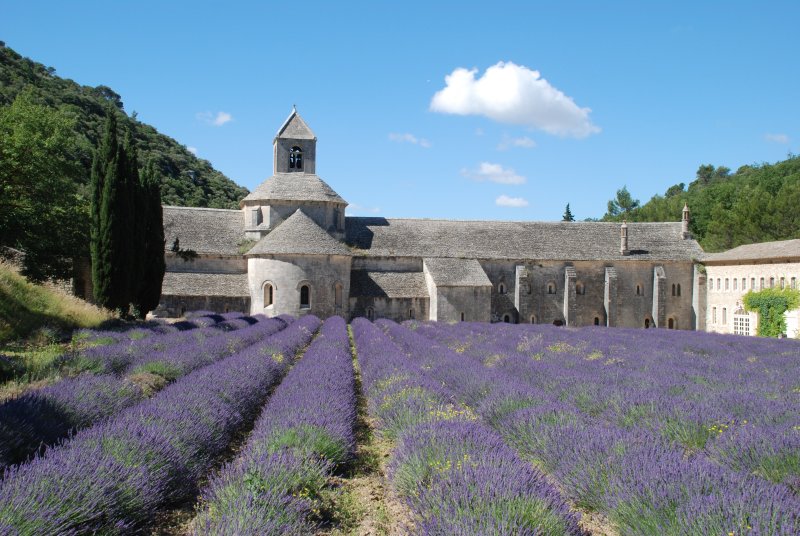
 EmDee, CC BY-SA
Sénanque Abbey: tickets, opening hours and what to see
Sénanque is a working Cistercian monastery. Its one-hour guided tour is in French only. The abbey advises the HistoPad tour for visitors who do not speak French.
In short
- The guided tour lasts one hour and is in French only. The HistoPad tour lets you go round on your own in other languages.
- Children under 6 enter free, and so does the third child under 18 visiting with parents.
- Sénanque is a working monastery: proper dress, silence, and no recording during services.
- The route covers the church, dormitory, cloister, warming room and chapter house, built in the 12th and 13th centuries.
- The lavender fields are off limits, to protect the monks’ harvest.
- The public car park is free, 5 minutes on foot from the entrance.
- 1148monks from Mazan found the abbey
- Almost 60 yearsof building, completed in 1220
- 10 or 11HistoPad languages, depending on which official page you read
- 1 hourthe guided tour, in French only
Don't miss
The abbey church
A tau-cross plan whose liturgical east end faces north, squeezed by the narrow valley.
The cloister
Look at the capitals of the paired columns, cut down to the simplest leaf forms.
The warming room
The one heated space in the abbey, where the monks could write.
The graffiti
Marks left on several medieval walls when the monastery stood open to all after 1903.
Sénanque Abbey tickets: how to get them
Sold by abbaye-senanque.tickeasy.com, at the official price.
| Ticket | Adult |
|---|---|
| Non-guided tour with a HistoPadStandard entry | €8Student €6 · Child €4 |
| Guided tour (in French)Guided tour | €8Student €6 · Child €4 |
Free entry (2026)
- Under 18s
Which ticket is right for you?
You follow spoken French
Guided tour (in French)
One hour with a professional guide, at set departure times. French only.
You do not speak French, or prefer your own pace
Non-guided tour with a HistoPad
You go round on your own with an augmented-reality tablet that recreates scenes from the monks’ daily lives, from the Middle Ages to the present day. 11 languages on the official visits page, English included.
Guided tour in French or HistoPad
The abbey sells two visits through its official ticketing, linked from its website. Both take you through the medieval parts of the abbey: the dormitory, the church, the cloister, the warming room and the chapter house.
The abbey highly recommends the guided tour and advises the HistoPad for visitors who do not speak French. The two official pages do not give the same list: the visits page names eleven languages, Chinese included, while the ticketing page names ten, without Chinese.
Who pays less, who pays nothing
- Under 6: free, as are guides on presentation of their card, priests and members of a religious order.
- Children from 6 to 17: child rate, and free from the third child under 18 visiting with his or her parents.
- Students from 18 to 25: their own rate, on presentation of the student card.
The amounts are in the ticket table above.
Avoid this mistake
Groups book by email, not with individual tickets: the abbey warns that individual tickets reserved for a group may be cancelled.
Visiting a working monastery
Just like in the 12th century, a community of Cistercian monks lives at Sénanque, following the Rule of Saint Benedict.
During the tours the monks stay in the monastic enclosure, where they keep praying, and they ask you to respect the atmosphere of silence and contemplation.
The offices structure the monks’ day: the abbey says the monks gather seven times a day in the abbey church to pray together, and every service is open to the public. It lists the liturgy of the hours as Vigils, Lauds, the minor hours (Terce, Sext, None), Vespers and Compline. On Mondays, the community’s desert day, Lauds and Mass are celebrated together. The published schedule differs on Sundays and Mondays and does not show all seven prayers as public services, so use the abbey’s Masses and Services page for the times.
Good to know
The medieval abbey has many stairs: access for people with reduced mobility is particularly difficult, and impossible in a wheelchair. The community has undertaken a restoration program to make the abbey accessible.
The lavender in front of the abbey
The monks grow lavandin, keep an apiary and tend an olive grove. Products made from their lavandin essential oil, their honey and their olive oil, with monastic hospitality, bring in the income that pays for restoring the abbey.
Wikipedia notes that the lavender is visible in front of the abbey.
Access to the lavender fields is forbidden, to preserve the monks’ harvest.
The abbey shop sells the abbey’s own products and monastic products from more than fifty abbeys and monasteries, along with local products and a large bookstore. It keeps its own opening hours, published on the abbey’s website.
What the route shows you
The French visits page lists the abbey church, the former dormitory, the cloister, the warming room and the chapter house, built in the 12th and 13th centuries. A visit leaflet can be downloaded in 8 languages before you go.
Read moreShow less
- The abbey church: built on a tau-cross plan, with an apse projecting beyond the outer walls. Its liturgical east end faces north, because the narrow valley left no room for the usual orientation, according to Wikipedia. The grave of Geoffroy of Venasque, a lord, lies inside. The abbey says it seems to indicate that he was a great benefactor of the building work.
- The cloister: Wikipedia points out the capitals of the paired columns, reduced to the simplest leaf forms so as not to offer distraction.
- The warming room: the one heated space in the abbey, where the monks could write. Wikipedia calls it their scriptorium.
- The walls: after the monks were evicted in 1903, the monastery stayed open to all, and graffiti can still be seen on several medieval walls.
With Silvacane and Le Thoronet, Sénanque is sometimes called one of the “Three Sisters of Provence”.
How the abbey came to its valley
The community settled in a valley 1 kilometer long and 300 meters wide. The name probably comes from the river Sénancole, from the Latin sana aqua, pure water.
- 1148 a dozen Cistercian monks from the monastery of Mazan, in Ardèche, found the abbey on June 23. It is the fourth Cistercian abbey in Provence, after Le Thoronet, Aiguebelle and Silvacane.
- 1220 the abbey is completed, after almost 60 years of building.
- 1544 an armed group of Waldensians from Cabrières attacks. Fire destroys the south part of the monastery, with the refectory, the cloister fountain and the lay brothers’ buildings.
- 1792 sold as national property on September 24. The new owner removes the cross from the church and its 3 bells.
- 1988 on November 26, part of the Cistercian community of Lérins goes to Sénanque.
The State classified the oldest part of the buildings as a Historical Monument on March 17, 1921.
Getting there and parking
- By road: at Coustellet, take the D900 towards Gordes. Just after the entrance to Gordes, turn left onto the D177 towards Venasque. The abbey is 5 kilometers after the crossroads.
- Leaving: the abbey’s access page, whose header is dated June 1, 2020, says the D177 you arrived on is one way when leaving, from March 15 to September 30. From the public car park, it says to take the D177 left towards Venasque, then after 4 kilometers the D244 right towards Gordes, and that this route is permanent for buses, camper vans and trucks. Check the signs on the road, since the page is old.
- On foot: a 30-minute hike from the village of Gordes.
- By train: Cavaillon station is 21 km away, L’Isle-sur-la-Sorgue 22 km, Carpentras 23 km and Avignon 40 km.
The public car park is free, 5 minutes on foot from the abbey entrance. Staying the night and camping there are forbidden.
Opening hours
| Period | Days | Hours |
|---|---|---|
| All year | Monday to Saturday | 9:45 am to 11 am (last entry) |
| All year | Monday to Saturday | 1 pm to 5 pm (last entry) |
| All year | Sunday | 1 pm to 5 pm (last entry) |
Before you go
- Proper dress is required, and the monks ask you to keep the silence of the place during tours.
- Photos for personal use without a tripod are allowed, even during the visits. No photo, video or sound recording during services. Shoots with models or professional equipment are forbidden inside and outside the abbey.
- Drone overflights are strictly forbidden in the valley and over the abbey.
- Dogs and other pets are not allowed inside, except assistance dogs.
Accessibility
- Wheelchair access
- Not wheelchair accessible
Map and nearby sights
Frequently asked questions
Is the Sénanque guided tour in English?
No. The guided tour is in French only and lasts one hour. For other languages, the abbey advises the non-guided tour with a HistoPad.
Can you walk in the lavender fields at Sénanque?
No. Access to the lavender fields is forbidden, to preserve the harvest of the monks.
Is there a dress code at Sénanque Abbey?
Yes. Proper dress is required, because the abbey is a place of monastic life, and visitors are asked to respect the silence.
Can I attend Mass or the offices?
Yes. All services celebrated by the monks are open to the public. Photos, video and sound recording are not allowed during them. Check the Masses and Services page for the times.
Is Sénanque Abbey wheelchair accessible?
No. The medieval abbey has many stairs, and access is impossible in a wheelchair.
Can I fly a drone over the abbey?
No. Drone overflights are strictly forbidden in the valley and over the abbey.
Sources
- abbaye-senanque.tickeasy.com official
- senanque.fr official 4 pages
- Wikimedia Commons
- wikidata.org
Facts last checked on 26 October 2026. Prices and opening hours change, often in January: confirm on the official website before you go.