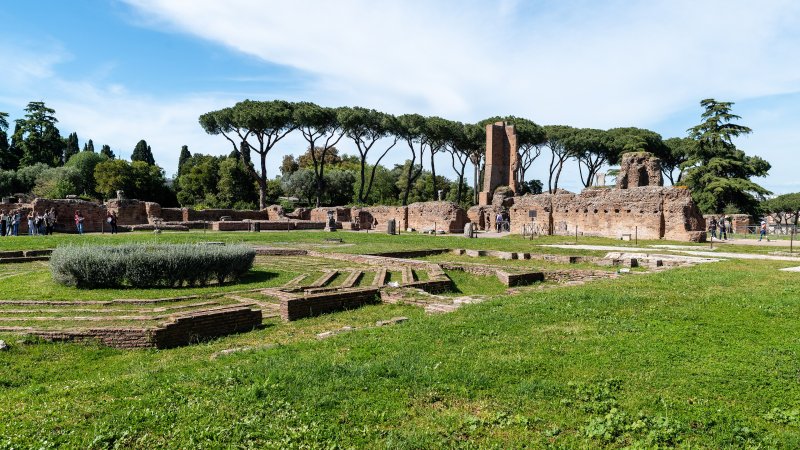
 Christoph Strässler, CC BY-SA
Palatine Hill: tickets, opening hours and what to see
The Palatine shares its entry with the Roman Forum. The open hill is on every Colosseum ticket, but the House of Augustus, the Aula Isiaca and the Palatine Museum are SUPER sites, which the 24-hour ticket does not list.
In short
- The Palatine shares one entry with the Roman Forum, sold on the same tickets as the Colosseum park.
- The 24-hour ticket covers the open-air hill. The House of Augustus, the Aula Isiaca and the Palatine Museum sit on the Full Experience and Forum Pass SUPER lists.
- On the free first Sunday of the month, those buildings and the Farnese Aviaries stay closed.
- The hill has its own entrance at Via di San Gregorio 30, near the Colosseo stop on metro line B.
- The way to the summit has a few short, steep stretches on irregular paving. The museum has an elevator and two stairlifts.
- 10th c. BCfirst people living on the hill
- AD 64the Great Fire destroys Nero’s Domus Transitoria
- 16 mdepth of the cavity found under the House of Livia
- 7tactile panels on the hill and in the museum
Don't miss
The House of Augustus
The emperor’s own residence, a group of several buildings. It is closed on Mondays and is not on the 24-hour ticket’s list.
The Palace of Domitian
The complex that dominates the hill, with the public Domus Flavia, the private Domus Augustana and the Palatine Stadium.
The Neronian Cryptoporticus
One of the best-preserved of the underground passages that linked the imperial residences.
The Horti Farnesiani
What remains of the Farnese family’s gardens, on the upper part of the hill above the Domus Tiberiana.
The Palatine Museum
Finds from digs on the hill since the 16th century, in what is left of the Villa Mattei. The ticket lists the lower floor only.
Palatine Hill tickets: how to get them
No separate ticket: the visit is made with a Colosseum Archaeological Park ticket.
Sold by ticketing.colosseo.it, at the official price.
| Ticket | Adult | Good to know |
|---|---|---|
| Forum Pass SUPERStandard entry | €18Young person, EU nationals and residents €2 | Name on ticket · ID checked at entry |
| Colosseum, Roman Forum and PalatineTimed entry | €18Young person, EU nationals and residents €2 | Timed slot · Booking required · Name on ticket · ID checked at entry |
| Full Experience ArenaTimed entry | €24Young person, EU nationals and residents €2 | Timed slot · Booking required · On sale 7 days ahead · Name on ticket · ID checked at entry |
| Full Experience AtticTimed entry | €24Young person, EU nationals and residents €2 | Timed slot · Booking required · On sale 30 days ahead · Name on ticket · ID checked at entry |
| Full Experience Underground and ArenaTimed entry | €24Young person, EU nationals and residents €2 | Timed slot · Booking required · On sale 30 days ahead · Name on ticket · ID checked at entry |
| Membership CardAnnual pass | €50Family €80 · Young person €25 | Name on ticket · ID checked at entry |
| Only ArenaPartial access | €18Young person, EU nationals and residents €2 | Timed slot · Booking required · Name on ticket · ID checked at entry |
| A Night at the Colosseum 2026Evening entry | €50Child Free · Young person, EU nationals and residents €28 | Booking required · On sale 7 days ahead · Name on ticket · ID checked at entry |
| A Night at the Roman Forum 2026Evening entry | €35Child Free · Young person, EU nationals and residents €19 | Booking required · On sale 7 days ahead · Name on ticket · ID checked at entry |
| Full Experience Passage of CommodusGuided tour | Price on the official site | Timed slot · On sale 7 days ahead · Name on ticket · ID checked at entry |
| Horrea PiperatariaGuided tour | €26 | Timed slot · Name on ticket · ID checked at entry |
Free entry (2026)
- Teachers
- Under 18s
- Visitors with disability and one companion
- First Sunday of the month (next: Sunday 1 November)
Which ticket is right for you?
The open-air hill and the Forum are enough
Colosseum, Roman Forum and Palatine
It opens the open-air hill, with a single entry to the Forum and the Palatine together.
You want inside the House of Augustus, the Aula Isiaca or the Palatine Museum
Full Experience tickets or Forum Pass SUPER
These buildings are SUPER sites, on their lists and not on the 24-hour ticket’s.
You come on the free first Sunday of the month
Free first Sunday
The Farnese Aviaries stay closed, as do the House of Augustus, the Aula Isiaca and the Palatine Museum. The Domus Tiberiana stays open, without its exhibition rooms.
One entry for the hill and the Forum
The Palatine is sold on the same tickets as the Roman Forum: the park treats the two as one archaeological area, the Roman Forum-Palatine, and each ticket gives you a single entry to it.
The guide to the Colosseum park tickets explains which one to buy. On the hill, the difference is in which buildings you can enter.
The 24-hour Colosseum, Roman Forum and Palatine ticket opens the open-air hill. These Palatine buildings are on the Full Experience and Forum Pass SUPER lists, not on the 24-hour ticket’s:
- the House of Augustus, closed on Mondays
- the Aula Isiaca and the Loggia Mattei
- the exhibition rooms of the Domus Tiberiana
- the Palatine Museum, lower floor only
- the House of Livia, which the ticket page flags as closed for restoration work, so check before counting on it.
Coming in from Via di San Gregorio
The park gives the Palatine its own address, Via di San Gregorio 30. For this address the park lists metro line B (Colosseo), tram 3 and six bus lines.
The climb is the part to plan for (see “Before you go”). What you find on the hill and at the entrance:
- Water: the park places drinking fountains near benches in the Horti Farnesiani, by the Domus Augustana and on the southern path, and vending machines in the Horti Farnesiani and in the Stadium of the Domus Augustana.
- Baby changing: the restrooms at this entrance have a baby changing station.
- Step-free access: the Palatine Museum has an elevator and two stairlifts.
- Tactile panels: three tactile panels stand on the hill and four more inside the Palatine Museum.
Why “palace” comes from this hill
The Palatine had two summits separated by a depression: the higher one was called Palatium, the lower one Germalus. The hill’s story runs from a village to the residence of the emperors:
- 10th century BC: People have lived here since the 10th century BC, and the park describes Iron Age settlements tied to the earliest core of Rome.
- 2nd to 1st century BC: Between the 2nd and 1st centuries BC it became the district of the Roman aristocracy, with houses decorated with paintings and paved floors, such as the House of the Griffins.
- Augustus: Augustus chose the hill for his own house, and from his time it gradually became the exclusive domain of emperors.
- The imperial palaces: The palaces followed one another: the Domus Tiberiana, Nero’s Domus Transitoria, the Domus Aurea, and finally the Domus Flavia.
Because the emperors lived here, the name Palatium came to mean a royal palace in modern languages.
What dominates the site today is the Palace of Domitian, rebuilt largely in his reign over earlier buildings of Nero. The last palace in the park’s list, the Domus Flavia, was divided into a public sector and a private one known as the Domus Augustana. The Palatine Stadium belongs to the same complex, and later emperors, the Severans above all, added the Domus Severiana.
The houses of Augustus and Livia
Augustus’s house consisted of several buildings, among them the one known as the House of Livia, after his wife.
That name rests only on a lead pipe bearing a generic name and on the building’s closeness to the House of Augustus. It stands near the Temple of Magna Mater at the western end of the hill, on a terrace below the temple, and it is known for its frescoes.
In 2007, a cavity 16 meters deep with a vault covered in mosaics and seashells was found beneath the House of Livia during restoration work. Two readings of it are on record:
- It was claimed as the Lupercal, the cave where, in the legend, the she-wolf kept Romulus and Remus alive.
- Others reject that identification and see a Neronian nymphaeum or underground dining room instead.
Passages under the palaces
The palaces overlap, and their plans show how the residences were linked partly by underground passages, often richly decorated. The Neronian Cryptoporticus is one of the best preserved of them.
The park’s list of Palatine marvels also includes the Domus Transitoria, Nero’s first palace. That palace was destroyed in the Great Fire of AD 64. Nero replaced it by AD 69 with the larger Domus Aurea, over which Domitian’s palace was eventually built.
The Farnese Gardens and the museum in a convent
From the 16th century, the hill belonged to aristocratic families who built villas and planted vineyards and gardens.
- 16th century The Palatine Museum occupies what is left of the Villa Mattei, built in the 16th century between the Domus Flavia and the Domus Augustana.
- Around 1830 the Scot Charles Mills turned it into a neo-Gothic villa.
- Late 19th century the villa became a convent.
- From 1928 the convent was partly demolished to allow excavations.
The Farnese family owned it, and part of their Horti Farnesiani survives on the upper part of the hill, above the remains of the Domus Tiberiana.
The Palatine Museum has had several lives before its finds moved in:
The museum now displays some of the most significant finds from digs on the hill since the 16th century. The Loggia Stati-Mattei, with its painted decoration, also survives from that period.
Opening hours
| Period | Days | Hours |
|---|---|---|
| 1 October to 24 October | Every day | 9 am to 6:30 pm last entry 5:30 pm |
| 25 October to 31 December | Every day | 9 am to 4:30 pm last entry 3:30 pm |
| ||
Before you go
- Your ticket gives a single entry to the Forum and the Palatine together: see both before you walk out.
- The park says that reaching the summit, although not particularly difficult, still involves several brief stretches of relatively steep paths and generally irregular paving.
- Coming for the House of Augustus? It is closed on Mondays and on the free first Sunday.
- To start on the hill, use the Via di San Gregorio 30 entrance.
Accessibility
- Lift
- Yes
Map and nearby sights
Frequently asked questions
Is the Palatine Hill included in the Colosseum ticket?
Yes. The 24-hour Colosseum, Roman Forum and Palatine ticket opens the open-air hill, with one entry to the Forum and the Palatine together.
Can I visit the House of Augustus with the 24-hour ticket?
No. The House of Augustus, the Aula Isiaca and the Palatine Museum are on the Full Experience and Forum Pass SUPER lists, not on the 24-hour ticket’s. The House of Augustus is also closed on Mondays.
Where is the Palatine Hill entrance?
The park gives the Palatine its own address, Via di San Gregorio 30. It lists metro line B (Colosseo), tram 3 and six bus lines for it.
Is the Palatine Hill a hard climb?
The park calls it not particularly difficult, but the way up has several brief, relatively steep stretches and irregular paving. Drinking fountains stand near benches in the Horti Farnesiani, by the Domus Augustana and on the southern path.
Is the Palatine Museum open on the free first Sunday?
No. On that day the Palatine Museum, the House of Augustus, the Aula Isiaca and the Farnese Aviaries stay closed. The Domus Tiberiana is open, without its exhibition rooms.
Nearby
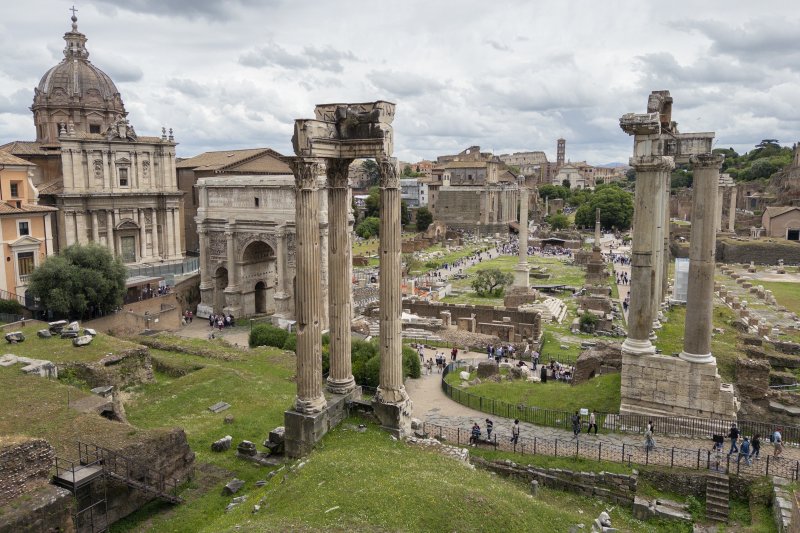 Nhartmannphotos, CC BY-SAArchaeological site0.5 km away
Roman Forum
The Curia Iulia. The Senate House rebuilt by Julius Caesar, saved as the church of Sant’Adriano. It is not on the 24-hour ticket.Rome, Italyfrom €18
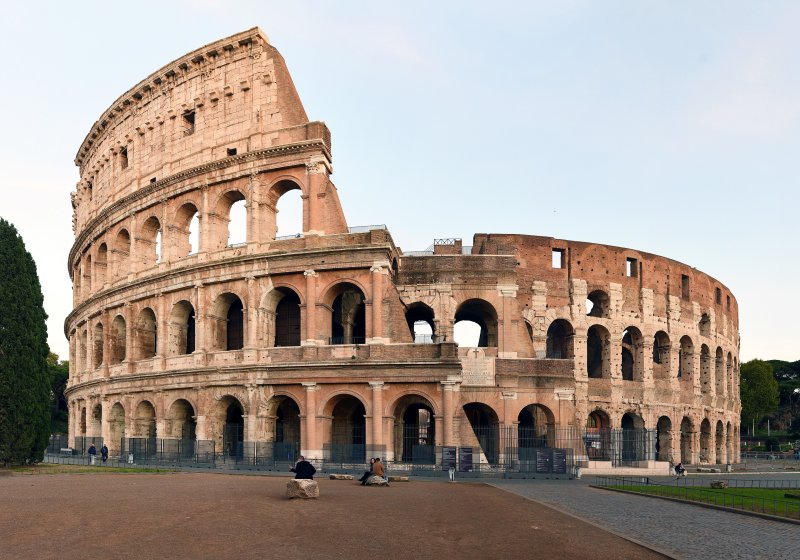 FeaturedPics, CC BY-SAArchaeological site0.5 km away
Colosseum
The arena floor. From the arena floor you see the whole cavea at once, the ring of seating that held the spectators.Rome, Italyfrom €18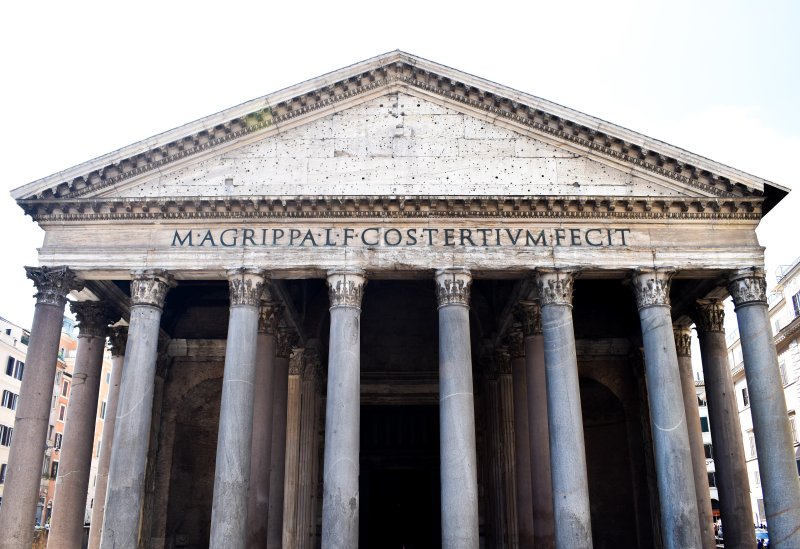 Julian Lupyan, CC0Landmark1.4 km away
Pantheon
The oculus. The open eye at the top of the dome has never been covered: rain lands on the floor and runs off through drains in the paving.Rome, Italyfrom €7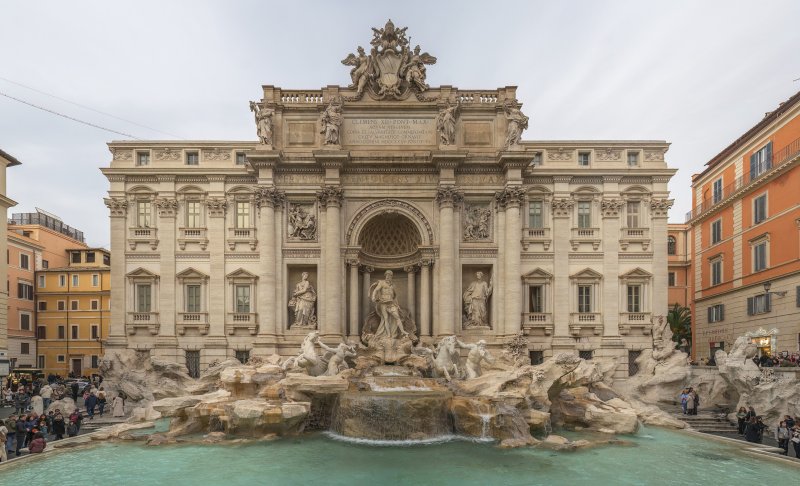 Wilfredor, CC0Landmark1.4 km away
Trevi Fountain
Oceanus and his chariot. In the central niche, Pietro Bracci’s Oceanus drives a shell-shaped chariot pulled by a restive horse and a calm one.Rome, Italyfrom €2Sources
- colosseo.it official 20 pages
- Wikimedia Commons 3 pages
- Wikipedia
- wikidata.org 2 pages
Facts last checked on 15 October 2026. Prices and opening hours change, often in January: confirm on the official website before you go.